
On this page


Thin-Film Solar Cells and New Technologies
Whilst crystalline silicon cells dominate the market, there are exciting alternatives: thin-film technologies are more flexible and lighter, whilst perovskite and tandem cells offer the highest efficiency potential.
Thin-Film Solar Cells: The 2nd Generation
Thin-film cells differ fundamentally from crystalline cells:
| Property | Crystalline | Thin-Film |
|---|---|---|
| Thickness | 150–200 µm | 1–10 µm |
| Flexibility | Rigid | Flexible possible |
| Weight | Heavy | Light |
| Material consumption | High | Low |
| Efficiency | 20–24% | 10–20% |
Amorphous Silicon (a-Si)
The oldest thin-film technology:
| Property | Value |
|---|---|
| Efficiency | 6–10% (commercial) |
| Thickness | ~1 µm |
| Application | Calculators, watches, BIPV |
Advantages:
- Very low-cost manufacturing
- Flexible on various substrates
- Good low-light performance
Disadvantages:
- Low efficiency
- Degradation under light (Staebler-Wronski effect)
Cadmium Telluride (CdTe)
The most successful thin-film technology:
| Property | Value |
|---|---|
| Efficiency | 17–19% (commercial) |
| Max. laboratory | 22.1% |
| Market leader | First Solar (USA) |
Advantages:
- Low-cost mass production
- Fast energy payback
- Good temperature coefficient
Disadvantages:
- Cadmium is toxic (but safely encapsulated)
- Tellurium is rare
- Recycling required
CIGS (Copper Indium Gallium Selenide)
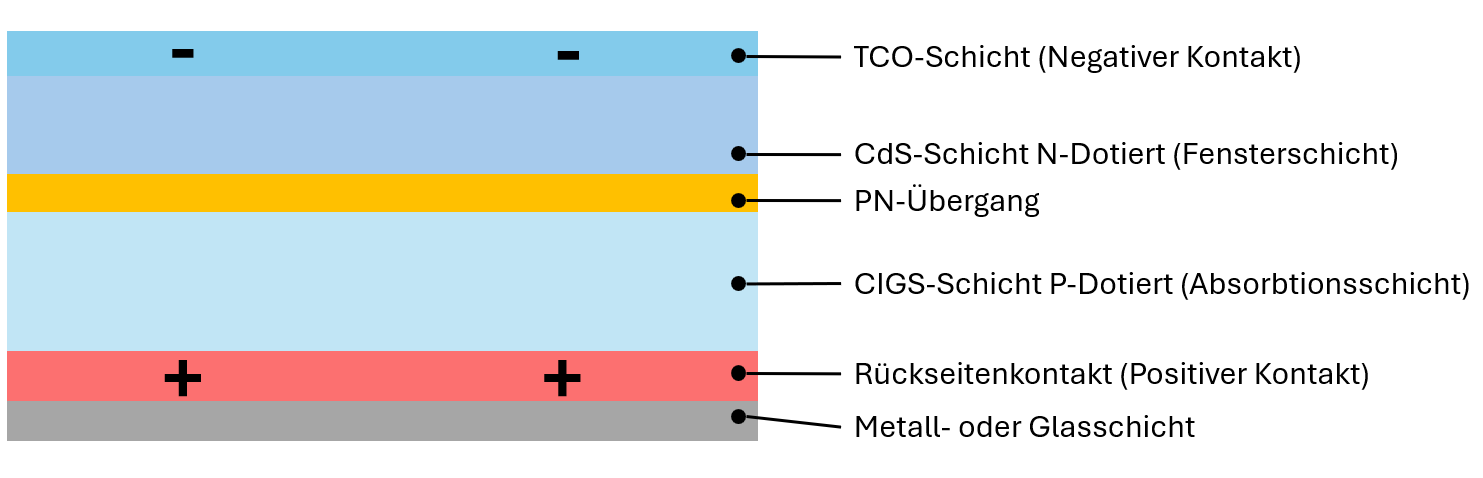 Layer structure of a CIGS thin-film cell
| Layer | Function |
|---|---|
| TCO layer | Negative contact, transparent |
| CdS layer | N-doped window layer |
| CIGS layer | P-doped absorber layer |
| Rear contact | Positive contact |
| Substrate | Metal or glass |
| Property | Value |
|---|---|
| Efficiency | 15–18% (commercial) |
| Max. laboratory | 23.4% |
| Thickness | 2–4 µm |
Advantages:
- High efficiency for thin-film
- Can be manufactured flexibly
- Good low-light performance
- No degradation
Disadvantages:
- Complex manufacturing process
- Indium is expensive and rare
- Not as affordable as CdTe
The 3rd Generation: Future Technologies
Perovskite Solar Cells
Perovskite cells are the "rising stars" of solar research:
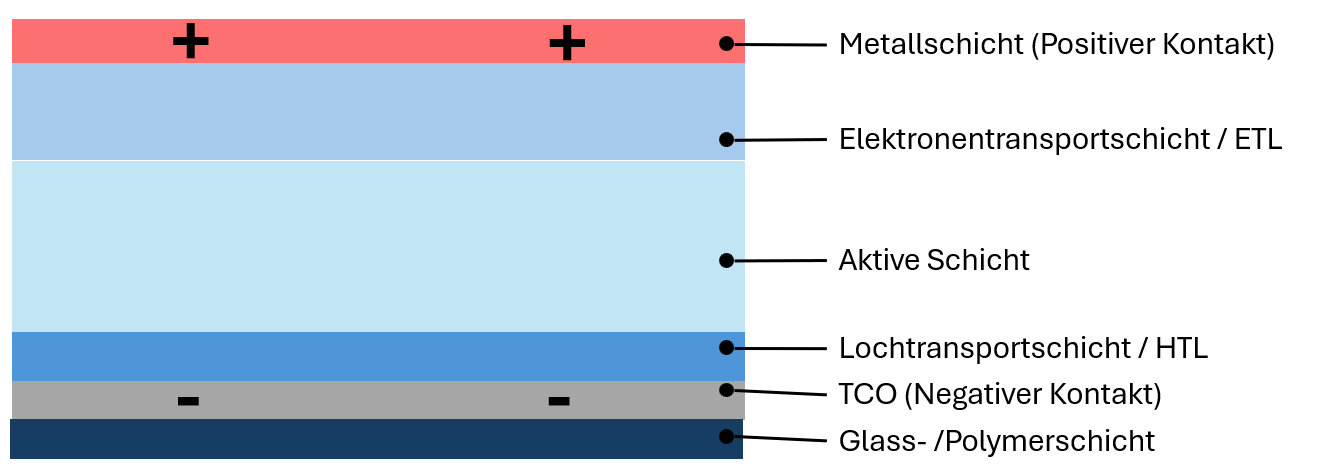 Layer structure of a perovskite solar cell
| Layer | Function |
|---|---|
| Metal layer | Positive contact |
| ETL | Electron transport layer |
| Active layer | Perovskite crystals |
| HTL | Hole transport layer |
| TCO | Negative contact |
| Substrate | Glass or polymer |
| Property | Value |
|---|---|
| Efficiency (laboratory) | 25.8% (single cell) |
| Development | From 3.8% (2009) to 25.8% (2023) |
| Costs | Potentially very low |
Advantages:
- Rapid efficiency improvement
- Low-cost materials
- Low energy input for manufacturing
- Printable production possible
- Flexible and lightweight
Disadvantages:
- Stability problems (moisture, heat)
- Contains lead (environmental concerns)
- Long-term stability not yet proven
- Not commercially available
Research highlight: The efficiency of perovskite cells rose from under 4% to over 25% in just 10 years – an unprecedented development in solar research.
Tandem Cells
Tandem cells combine multiple materials in one cell:
| Configuration | Max. Efficiency |
|---|---|
| Perovskite/Silicon | 33.7% (laboratory) |
| III-V Multi-Junction | 47.1% (concentrator) |
| Perovskite/Perovskite | 28.5% (laboratory) |
Operating principle:
- Upper cell absorbs high-energy light
- Transmitted light reaches lower cell
- Both cells contribute to current
Advantages:
- Highest efficiencies of all
- Better utilisation of the light spectrum
- Theoretical limit: >40%
Disadvantages:
- Extremely complex manufacturing
- Very high costs
- Mainly for space and concentrator PV
Organic Solar Cells (OPV)
| Property | Value |
|---|---|
| Efficiency | 10–15% (laboratory) |
| Material | Organic polymers |
| Thickness | <1 µm |
Advantages:
- Extremely light and flexible
- Transparent versions possible
- Printable production
- Low-cost materials
Disadvantages:
- Low efficiency
- Short lifespan
- Degradation from UV and oxygen
Comparison of All Thin-Film Technologies
| Technology | Efficiency | Cost | Flexibility | Market Readiness |
|---|---|---|---|---|
| a-Si | 6–10% | Low | High | Established |
| CdTe | 17–19% | Low | Low | Established |
| CIGS | 15–18% | Medium | High | Established |
| Perovskite | 20–26%* | Very low* | High | Research |
| OPV | 10–15%* | Low | Very high | Research |
| Tandem | 30–47%* | Very high | Low | Laboratory |
*Laboratory values, not commercially available
Application Areas
| Application | Suitable Technology | Reason |
|---|---|---|
| Building integration (BIPV) | CIGS, a-Si, Perovskite | Flexible, aesthetic |
| Façades | a-Si, OPV | Transparent possible |
| Mobile devices | a-Si, OPV | Light, affordable |
| Large solar parks | CdTe | Low-cost in volume |
| Space | III-V Tandem | Maximum efficiency |
| Wearable electronics | OPV | Ultra-light, flexible |
The Future of Solar Cells
Short to Medium Term (2025–2030)
- TOPCon takes market leadership from PERC
- Perovskite/Si tandem reaches market readiness
- Bifacial modules become standard
Long Term (2030+)
- Perovskite tandem as new standard technology
- Efficiencies >30% become affordable
- Building-integrated PV (BIPV) strongly growing
Forecast: By 2030, perovskite/silicon tandem modules could be commercially available, offering efficiencies of 30%+ at reasonable cost.
Conclusion
Key Point: Thin-film technologies like CdTe and CIGS have important niche applications but cannot dethrone crystalline silicon. The future belongs to perovskite and tandem cells: they promise efficiencies above 30% at potentially low costs. For homeowners today: don't wait for perovskite – current TOPCon/HJT modules are excellent and available.
Back to overview: All Photovoltaics Articles
Sources
- Pastuszak, J.; Węgierek, P.: Photovoltaic Cell Generations and Current Research Directions. Materials 2022
- NREL: Best Research-Cell Efficiency Chart
- Fraunhofer ISE: Photovoltaics Report 2024
- Green, M.A. et al.: Solar cell efficiency tables. Progress in Photovoltaics 2024