
On this page


Crystalline Silicon Solar Cells
Silicon-based cells belong to the first and oldest generation of solar cells. With a global production share of 97% (2023), they completely dominate the market.
Why Silicon?
Silicon is particularly well-suited for solar cells:
| Property | Advantage |
|---|---|
| Abundance | Second most common element in Earth's crust |
| Semiconductor properties | Ideal for photovoltaic effect |
| Stability | Long lifespan (25+ years) |
| Manufacturing experience | Decades of optimisation |
Monocrystalline vs. Polycrystalline
The main difference lies in the crystal structure:
Monocrystalline Silicon
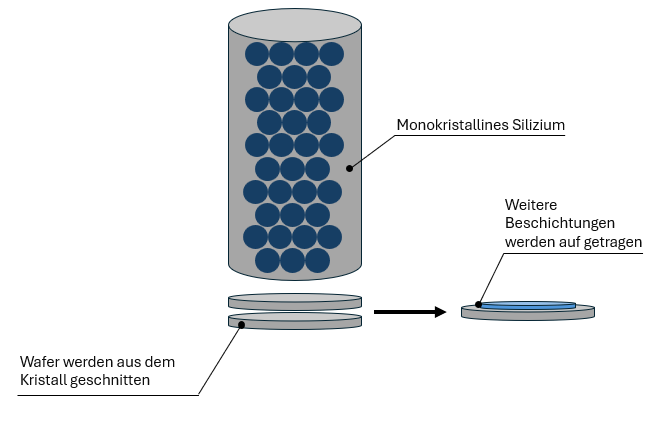 Czochralski process: Wafers are cut from a single crystal
| Property | Value |
|---|---|
| Structure | One continuous crystal |
| Colour | Dark blue to black |
| Efficiency | 20–24% (commercial) |
| Manufacturing | Czochralski process |
Advantages:
- Highest efficiency
- Long lifespan
- Best area efficiency
Disadvantages:
- Higher manufacturing costs
- More complex production process
Polycrystalline Silicon
| Property | Value |
|---|---|
| Structure | Many small crystals |
| Colour | Light blue, glittering |
| Efficiency | 17–19% (commercial) |
| Manufacturing | Casting process |
Advantages:
- Lower manufacturing costs
- Simpler production process
Disadvantages:
- Lower efficiency
- Declining market share
Market trend: Polycrystalline modules are increasingly being replaced by monocrystalline ones. The price difference has become minimal, whilst the efficiency difference remains significant.
Manufacturing Technologies in Detail
AL-BSF: The Classic Standard
AL-BSF stands for "Aluminium Back Surface Field" – the standard for decades.
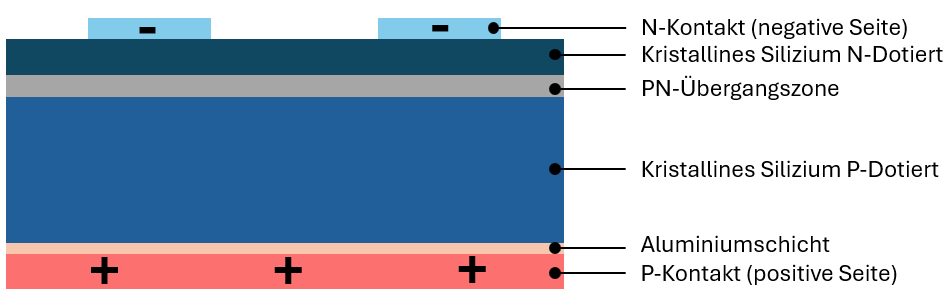 Layer structure of a classic AL-BSF solar cell
| Layer | Function |
|---|---|
| N-contact | Negative pole, current collection |
| N-doped silicon | Electron surplus |
| PN junction | Charge separation |
| P-doped silicon | Base material |
| Aluminium layer | Reduces recombination |
| P-contact | Positive pole |
Efficiency: 18–20% (commercial)
PERC: The Evolution
PERC = "Passivated Emitter and Rear Cell" – an evolution of AL-BSF.
Improvements over AL-BSF:
- Additional passivation layer
- Local rear contacts
- Less recombination
| Aspect | AL-BSF | PERC |
|---|---|---|
| Efficiency | 18–20% | 21–23% |
| Recombination | Higher | Lower |
| Cost | Low | Moderate |
| Market share | Declining | Dominant |
PERC is currently the best-selling technology.
HIT/SHJ: Heterojunction Technology
HIT = "Heterojunction with Intrinsic Thin Layer" (also SHJ = Silicon Heterojunction)
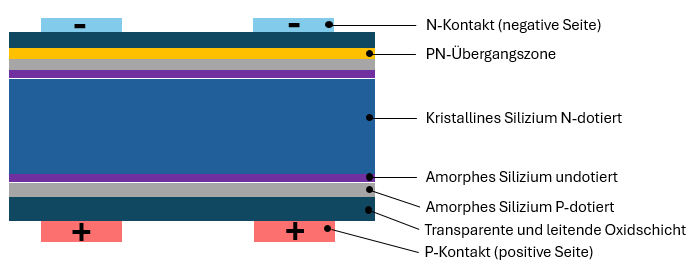 Combination of crystalline and amorphous silicon
| Layer | Material |
|---|---|
| N-contact | Metal grid |
| PN junction | Heterojunction |
| Crystalline Si | N-doped (base) |
| Amorphous Si | Undoped + P-doped |
| TCO | Transparent oxide layer |
| P-contact | Metal layer |
Advantages of HIT/SHJ:
- Very high efficiency (22–24%)
- Low temperature coefficient
- Bifacial use possible
- Longer lifespan
Disadvantages:
- More complex manufacturing
- Higher costs
TOPCon: The New Star
TOPCon = "Tunnel Oxide Passivated Contact" – the rising market leader.
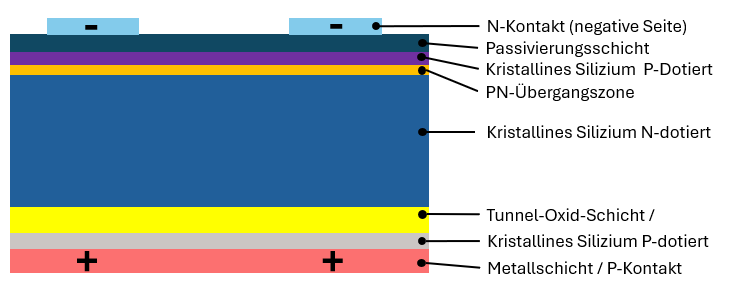 TOPCon: Tunnel oxide layer for maximum efficiency
| Layer | Function |
|---|---|
| N-contact | Current collection |
| Passivation layer | Reduces recombination |
| N-doped silicon | Base (N-type cell!) |
| PN junction | Charge separation |
| Tunnel oxide layer | Enables tunnel effect |
| P-doped silicon | Thin |
| P-contact | Current collection |
Special feature: The tunnel oxide layer utilises the quantum physical tunnel effect – electrons pass through, holes do not.
Advantages of TOPCon:
- Highest commercial efficiency (22–24%)
- Based on PERC production lines (conversion possible)
- N-type: No light-induced degradation
- Good low-light performance
Technology Comparison
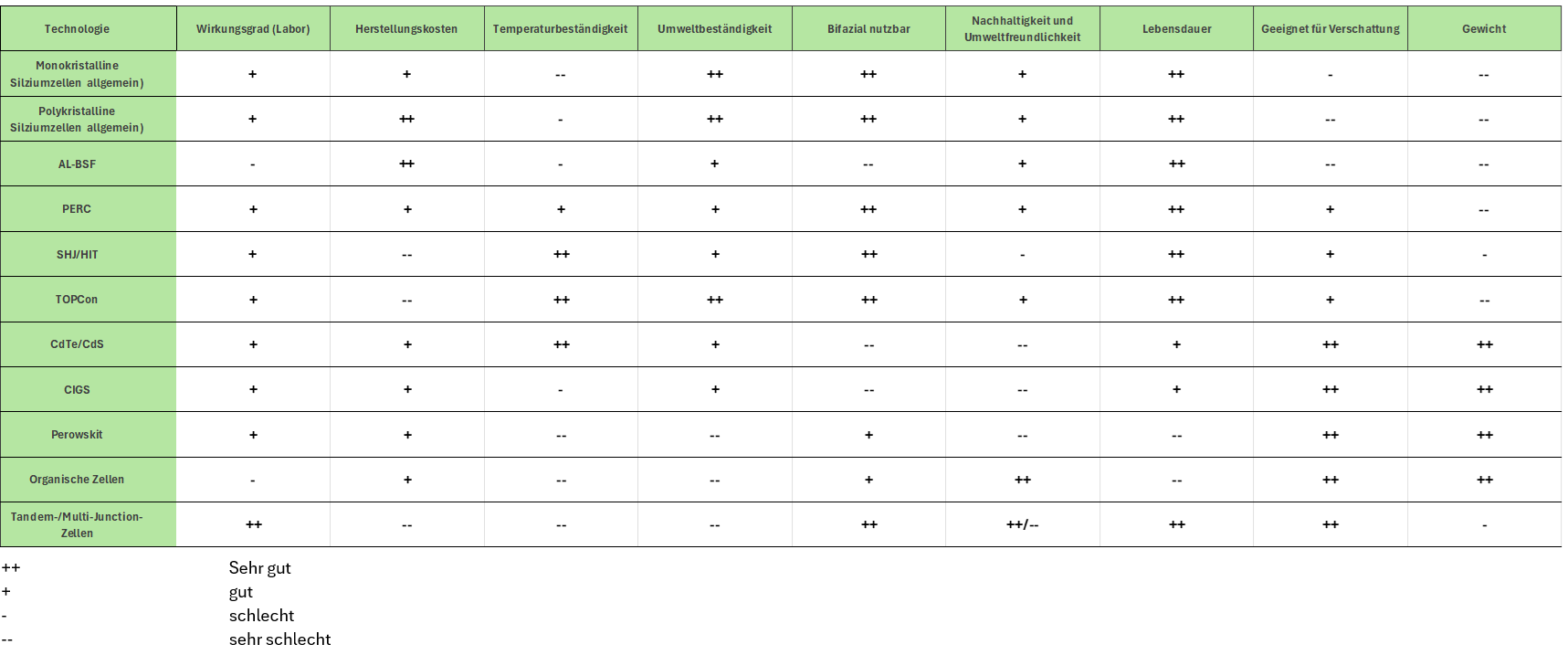 Rating: ++ very good, + good, - poor, -- very poor
Summary
| Technology | Efficiency | Cost | Trend |
|---|---|---|---|
| AL-BSF | 18–20% | Low | ↓ Phasing out |
| PERC | 21–23% | Moderate | → Stable |
| HIT/SHJ | 22–24% | High | ↑ Premium |
| TOPCon | 22–24% | Moderate | ↑↑ Strong growth |
Which Technology to Choose?
| Situation | Recommendation | Reason |
|---|---|---|
| Budget-oriented | PERC | Best value for money |
| Maximum efficiency | TOPCon or HJT | Highest efficiencies |
| Limited roof space | N-type (TOPCon/HJT) | More yield per m² |
| Balcony solar | PERC | Affordable and sufficient |
| Long-term investment | N-type | Lower degradation |
Conclusion
The Essentials: Crystalline silicon cells dominate with 97% of the solar market. The trend is clearly towards N-type cells: TOPCon will likely replace PERC as the standard technology. For new installations, TOPCon modules are recommended – they offer the best compromise of efficiency, longevity and price.
Continue reading: In the next article Thin-Film and New Technologies, you will learn everything about CdTe, CIGS, perovskite and tandem cells.
Sources
- Pastuszak, J.; Węgierek, P.: Photovoltaic Cell Generations and Current Research Directions. Materials 2022
- ITRPV: International Technology Roadmap for Photovoltaic 2024
- D. Pan, T. Guo, X. Chen: Silicon-based solar cell: Materials, fabrication and applications. ISCTIS 2021
- Lindroos, J.; Savin, H.: Review of light-induced degradation in crystalline silicon solar cells. Solar Energy Materials and Solar Cells 2016